I had to record this twice because I accidentally deleted the first recording, so if it sounds unusually coherent (which it won't), that's why. (By the way , even though this has nothing to do with the IOC, I just wanted to note that most of the photoshop things in this are manifestations of concepts that were created by my smart peers, and the music at the end is Hall of the Mountain King.)
Malcolm Gladwell: The unheard story of David and Goliath
In this TED Talk, Malcolm Gladwell tells the story of David and Goliath, adding outside knowledge that can be applied to the story to create a better understanding of the event. His main argument in the talk is that powerful people, or "giants," are not as difficult to overcome as they seem. Gladwell touches the idea of perspective, showing how in the case of David and Goliath, a lack of understanding of the perspective of each of the men makes their actions seem to be motivated by completely different factors than once their perspectives are understood. Gladwell analyzes the literary devices used in David and Goliath, noting how their subtlety makes the message of the story difficult to understand at first glance. Gladwell analyzes how dialogue contributes to the characterization of both David and Goliath. When offered armor to wear, David said, "I cannot wear this for I have not proved it." This hints at David's plans for combat, as he is an artillery soldier and plans to fight from a distance rather than in hand-to-hand combat. Goliath is characterized from the perspective of the Israelites as a powerful, humongous warrior. However, Goliath's dialogue reveals his weakness: Goliath has very poor vision. Goliath is incredibly vulnerable to long-range combat, so it is to be expected that in this battle, David would be victorious. Gladwell uses a few techniques to get his audience to believe his interpretation of David and Goliath. Gladwell cites many facts to support his argument, such as the geography of the region, the estimated momentum of the rocks, and the medical diagnoses of Goliath based on the story. This is used both as logos, to be used as evidence to support more general claims, and ethos, to add to the credibility of the argument by pulling evidence from a variety of areas of knowledge. Gladwell also uses logos by the order in which he presents new information. He controls the way in which conclusions are reached, coming to multiple conclusions throughout the talk before reaching the ones that he wants the audience to leave with. This shows the audience that Gladwell put thought into this argument, not simply stopping at the first answer he was able to find. The use of pathos in this talk is minimal, as the purpose of the talk lends itself more to logical deduction and more in-depth understanding of the situation. Emotional words are occasionally used, including "terrifying," "weird," and "strange." These words are used to align the audience with the emotion that Gladwell wants them to feel, in order to make the logical progression of the talk make a larger impression on the audience. These words tend to be used before Gladwell add new information to the situation, making the emotion a signal to the audience that they do not fully understand yet what is actually happening. I'm not completely sure why I picked this talk, but I'm glad I did. I've read a few of Malcolm Gladwell's books, and I enjoyed the way that he takes issues that seem to have one answer and analyzes them to logically find the answer that better fits the evidence. I was sure that anything involving him would be well thought out and would provide insightful revelations on the topic. I am not a religious person, so the biblical topic of the talk made me slightly nervous. I wasn't sure if most of the talk would go over my head or would focus on theology. However, I was surprised to find that the talk focused mostly on the real-life context of the story, including the culture, politics, and geography of the Levant. I like the message of the talk. I think that people tend to make things supernatural, as if they are too powerful to understand or change. It is nice to have Gladwell remind us that this we should be suspicious of this being the case.
#3. Double Indemnity has been called “a film without a single trace of pity or love.” Do you agree with this statement? Think about the motivations that lie behind the actions of Walter Neff and Phyllis Dietrichson when you consider your response.
Double Indemnity is a dark movie both in its lighting and its plot. However, the two most prominent characters in the film, Walter Neff and Phyllis Dietrichson, are motivated to kill Phyllis's husband because of their love for one another. How could anyone claim that this movie doesn't even have a trace of pity or love in it? During the movie, we begin to learn that Phyllis is a very dark character. Her step-daughter Lola claims that she killed Lola's mother while working as her nurse. When Walter strangles her husband, Phyllis can be seen making an awfully pleasant facial expression that makes the audience uncomfortable and foreshadows her comfort with killing others. Phyllis's motivation is revealed through the movie to be solely to benefit herself, and her attitude towards others is portrayed as sociopathic. The only hint of pity, and arguably love, shown by Phyllis is when she can't shoot Walter a second time, claiming that it was the only moment at which she loved him. I would argue that this was pity and not love because she had just shot him only moments before, suggesting that she did not have much care for Walter's well-being.
There's something on the wing! The Twilight Zone, which began in 1959, was influenced by both the film style and the dark content of film noir, focusing on the worst aspects of humanity and the natural world.
The definition of love comes into play when considering whether or not it was present in this movie. In its simplest form, love could be thought of as placing the interests and well-being of another person before your own. This can be seen when Walter gives a ride to Lola wen she lied to her parents about where she was going, and he kept that secret for her. He doesn't have to do this for her, and it takes away his valuable time and gasoline, but he chooses to help her anyway. However, this definition comes dangerously close to being a synonym for altruism, and doesn't seem to narrow down to what most people would consider love to be. Often, people think of love as being irrational and something that cannot be controlled. I would argue that the thinking behind love is nonrational, and reason is not even consulted when actions are driven by love, meaning that the resulting behavior can be either rational or irrational. Walter might fall into this refined definition in his early interactions with Phyllis. He helps her with her predicament and agrees to kill her husband without much persuasion. However, helping Phyllis is not the only reason that he agrees to the plan to commit insurance fraud. Walter was making a rational decision to participate in a money-making opportunity. He could justify to himself his cold instinct to benefit himself by imagining that he was actually acting in the name of love. This allowed him to keep some sort of sanity while committing evil actions. Overall, I would argue that there is not a trace of love in Double Indemnity, but there are instances of pity. These instances of pity are small and scarce, but they are shimmering lights of hope in a movie that paints humanity in an incredibly grim light.
Macduff is the best character in Macbeth. His name has the same number of syllables and letters as the main character's, and the first three letters are also the first three letters of the main character's name. Already he's drawing attention to himself. Who is this crazy guy trying to confuse us and pass himself off as the protagonist‽ Then his entire family is killed by an insane murderous king, and then he goes and kills that king! Two for two so far, this guy is on a roll! And even though he killed the king, he doesn't even get to be the king! Talk about integrity, this head-chopping Macduff guy is a solid role model. Who wouldn't want to get to the source of this man's moral principles? And of course there is no better way to learn good moral principles than to watch television. Without further ado, here's Macduff's Top 4-5 Favorite Shows that He Recommends that You Watch that Have Nothing to do with Oliver's Preferences when it comes to Television and Humor Although Oliver Does Have Very Good Taste When It Comes To Those Things.
Macduff's Top 4-5 Favorite Shows that He Recommends that You Watch that Have Nothing to do with Oliver's Preferences when it comes to Television and Humor Although Oliver Does Have Especially Good Taste When It Comes To Those Things
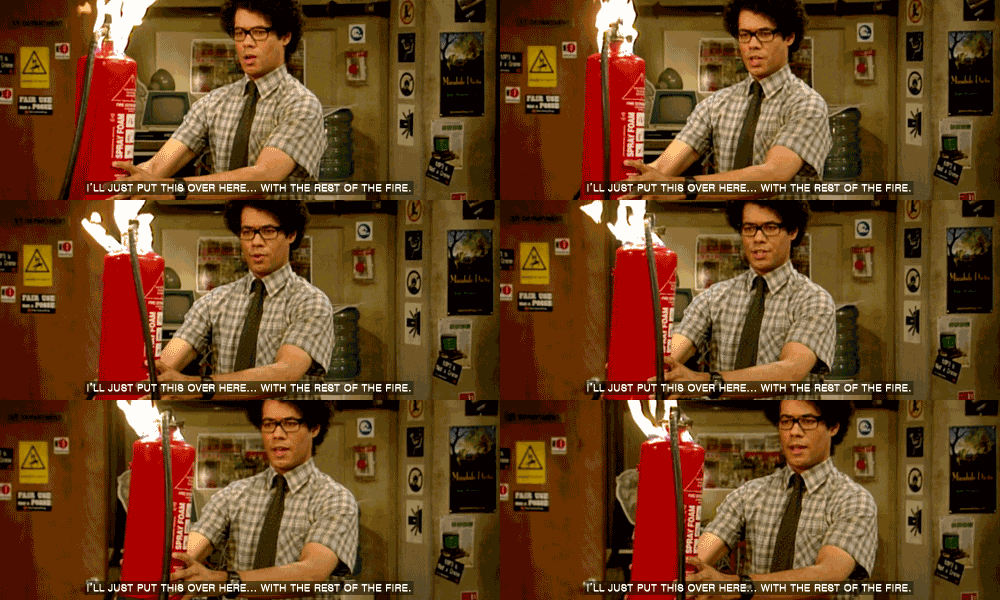
Dangerous situations present themselves often on The IT Crowd
#5 Or 4. The IT Crowd: Being from Great Britain, Macduff sure does like his dry humor, and this sitcom has plenty of it. Centered around three coworkers in the IT department of a large company, this show features painfully awkward situations and ridiculously dramatic events, things that Macduff can relate to from his interactions with Macbeth. Macduffs enjoys the struggle that the main characters face against eccentric and irresponsible bosses, as well as the humor found in the relationship between the different nations that make up the U.K.
#4, Maybe 3. The Return of the Pink Panther: I'm not sure if this is on Netflix anymore, but if it is Macduff totally recommends it. This 1975 film follows the famous Inspector Clouseau as he attempts to solve yet another mystery. There are plenty of scenes in which Clouseau and his assistant have long, intense fights that are meant to keep Clouseau alert and able to defend himself. However, they do a better job of destroying every object in sight. Macduff loves fight scenes and finds them very exciting, although he is able to keep his head if necessary (This is from a different pink panther movie, but it is a funny scene).
#2-ish Or Something Like That. Firefly: Now no good exploration of moral behavior would be complete without this sci-fi western. Set hundreds of years in the future in a solar system of colonized planets, the one-season series depicts the struggles of a rag-tag crew in their efforts to keep going while laying low in the hostile depths of interplanetary space. The show explores themes such as the relationship between people and their government, the problems of vast economic disparities, and the love and conflict associated with being part of a crew.
You get it? Because it says "going mad" and that's what Macbeth does in the play like there's justification for me to use this show in this post or something? (P.S. That other gif really doesn't connect to Macbeth at all but I put it in because it's funny. I mean he puts not one but two fingers in his mouth!)
Macduff's gotta include this show because the main character, Malcolm Reynolds, also has a very similar name to him, which would make it easy to confuse them if Macduff was a character in the show. Also, the show solves problems by killing people, which is the best way to solve your problems. But Macduff really loves this series because of the loyalty that Malcolm Reynolds has for and expects from his crew. Despite the universe's blatant indifference towards the survival of any human being, these guys manage to find a way to keep going, not because they are special, but because they manage to love each other and look out for one another no matter what happens. Macduff thinks that there's something beautiful about that.
Featured here from left to right are Large Rock Man & Captain Amelia. She is loyal to the British Crown and a strong fighter, just like Macduff!
#The Last One. Treasure Planet: Macduff tried to steer away from sci-fi as much as possible, but I guess he just couldn't resist this one. Treasure Planet surprisingly features characters on a quest to get to a planet that's core is made out of treasure. Which is realistic. Along the way, there are betrayals, murders, cover-ups: everything that Macduff loves to shed light on. Macduff can relate to the main character, who doesn't have a father figure in his life, because Macduff lost his entire family after they were all murdered by Macbeth. He also likes the lesson shown about how greed and disloyalty lead to negative consequences, as Macduff values loyalty and being content with what one has. This concludes Macduff's Top 4-5 Favorite Shows that He Recommends that You Watch that Have Nothing to do with Oliver's Preferences when it comes to Television and Humor Although Oliver Does Have Especially Good Taste When It Comes To Those Things
What is manliness? Who decides what is manly and what is not? In modern times, manliness is changing. Different groups in the United States interpret manliness in different ways. However, there is one constant in manliness, from plaid-shirted hipsters to men that are the most interesting to bloodlines of duck-hunters: facial hair. Facial hair is something that is unique to men, that only they have the ability to produce. It acts as a sort of certificate of manliness, telling others, "You can trust me; I am definitely 100% a real, manly man."
Even the most interesting man in the world knows that facial hair is key to being a manly man, and that Crush™ soda isn't the most terrible drink known to man.
This raises the question as to why men feel a need to prove that they are in fact "real, manly men." This makes more sense once you consider the advantages that come with being a male in a male-dominated society. With the inequality in pay and in attaining higher-level positions in the workplace between men and women, as well as the harsh views still held by some people of gender roles, there are advantages that exist for men in modern-day society. Social pressure for men to show their manliness in obvious ways makes it easier for people to be properly classified by others as either male or female and to be treated accordingly.
Similar to in The Shaggy Dog, in which Tim Allen faces challenges because of changes to his form, Lady Macbeth faces challenges with her form stopping her from being able to address her problems.
In Macbeth, the idea of manliness is interpreted in a similar way that emphasizes the physical aspects associated with being a man. When Lady Macbeth wants to take matters into her own hands and kill Macbeth, she asks spirits to, "make thick [her] blood," and to, "Come to [her] woman's breasts, And take [her] milk for gall." This shows that at the time, gender was seen as originating from the body and its physical composition rather than as a concept defined by society itself. However, Lady Macbeth asking for these physical changes also shows how the gender roles in Shakespeare's time defined men as being physically stronger than women. Although we may have a looser connection today between gender and physical strength, the idea of strength is still a part of what makes a "good man" in our culture. There are many aspects to manliness that still separate men from women today. Men are discouraged from sharing their emotions with others. This isolates men from others, but it also stems from the idea that men should be strong. Emotions are difficult to control and are a huge part of who we are as individuals. For a man to share something that close to him would make him weak, as other men could use that against him for their own gain. The elements of manliness that still linger in and compose our culture define a good man as a strong man. Being male, I don't like to think that manliness influences my actions or thinking at all, but it certainly does. I do absurd things in the name of concepts like strength, independence, and endurance. No, I don't need any help writing with my sprained wrist. No, I don't need to use the heat in my car when it's 30 degrees outside. No, I can carry this baby elephant up 30 flights of stairs by myself, because I am a strong, independent MAN who can complete any task without assistance. From my personal experience, being a good man involves acting in an irrational manner in order to present how strong and useful you are to others. Macbeth also acts in an irrational manner in the name of being manly. However, my irrational behavior doesn't involve killing all of my friends in a delirious attempt to fulfill a prophecy and crown myself king. Lady Macbeth pushes Macbeth to kill King Duncan by peer pressuring him, claiming that, "When you durst do it, then you were a man." Apparently it is totally manly to kill people. But Lady Macbeth pushes it even further, saying, "to be more than what you were, you would be so much more the man." So killing people that have a cool job so that you can take their job and have a better job is the manliest thing you can do in the early 17th century. Seems like they needed some Netflix or something to calm them down.
This image vaguely ties in to the content of this blog post.
I also find that being a good man involves being ignorant of certain things. I don't know if a cardigan is an article of clothing or a country that Fox News wants to stop all air travel to and from. I couldn't tell you the difference between eyeliner and eyeshadow if my eyes depended on it. A good man has to be ignorant of things that aren't manly. Macbeth interprets manliness as almost the exact opposite when he hides knowledge of the killing of Banquo from Lady Macbeth. He tells her to, "Be innocent of the knowledge, dearest chuck,till thou applaud the deed." As a man, he feels the need to protect Lady Macbeth from unsettling knowledge, using his strength to handle the unsavory deed. In Macbeth, manliness is represented as almost a synonym for courage. As a man, you must be strong enough to overcome your fears and your doubts, and you must take on the dirty work that has to get done. As we can see from the reading, it seems like it is going pretty well for Macbeth, and it isn't affecting him mentally or emotionally in the slightest.
WATCH_DOGS is a totally next-gen video game produced by Ubisoft Entertainment, which was released as one of the first titles for the PlayStation 4. As part of a joint effort to advertise the new console and the original title taking advantage of its next-gen potential, this advertisement appeared on YouTube in the spring of 2014, a couple months before Watch Dogs was released (on May 27, 2014).
When first watching this advertisement, one can see that this game features much violence. Between explosions, gunshots, and police chases, it is clear that this game features the classic anti-hero, fighting the law and using vigilante justice to right wrongs. The advertisement also shows that in-game video can be shared using the PlayStation Network, inviting the player to share more easily with friends and suggesting that the high-quality graphics and gameplay will be worth other people's time.
The advertisement has a layer of irony to it. The song that is played has a cheerful tone and has optimistic, altruistic lyrics, such as, "it sure feels fine when I can share with you," and, "sharing means caring." These contrast with the visuals of the gameplay, showing gratuitous violence and destruction. If the song and the game are viewed as two different characters in the advertisement, this is a classic comedy duo, with the game playing the part of the straight man. This result in dramatic irony, as the audience is aware of this clash of ideas while the characters act as if they are ignorant of it.
Watch Dogs has a classic revenge-driven plot, where the death of Aiden Pearce's niece leads him to take on a vigilante mission to destroy her murderer. Knowing this, the advertisement can be seen as using wrath as a means to encourage gamers to buy this game and this console. Players can take on the role of a hacker determined to avenge his niece's death, and the violence in the advertisement is a medium for players to take out their own anger in a socially-acceptable fashion.
Like many titles released by Ubisoft, Watch Dogs is tailored towards a narrow audience of gamers. Featuring a gruff white male as the main character, the game appeals to a white male audience, mostly within the 17-35 age group. The use of explosions and action scenes is part of an effort to be exciting to this audience, which is often the target of action movies and video games.
Myself being within this target market, I feel that the advertisement is somewhat successful. When I first saw it, I really enjoyed it. Between the catchy, happy tune and the crisp 1080p visuals, I was excited for this amazingly-detailed open world game to be released. I was not drawn in by the violent actions of Aiden Pearce, but the gameplay mechanic of hacking the environment seemed unique and innovative. However, the advertisement failed to get me excited for the PlayStation 4, because I already have a PlayStation 3 and a computer, which both do the thing that the PlayStation 4 does: let me play games. Also, I became much less excited for Watch Dogs once I researched about the game, which I was prompted to do by seeing this advertisement.
The method used by Ubisoft and Sony to appeal to this audience is in part based on stereotypes. The standard gamer is thought of in popular culture as a young male that is driven to excitement by destruction and action. However, me and many other gamers find excessive violence to be nonsensical or boring if it is not used as a means to make a statement about society. Also, female gamers are often an afterthought if they are not completely overlooked.There is not even a single female presented in the ad, neither through a virtual character nor one of the voices heard in the ad.
Watch Dogs is held as the standard for the video games currently being released for the next console generation. However, between ridiculous glitches, simple-minded AI, and questionable moral ramifications for the game's reward and punishment systems, it has many problems that perfectly exemplifies the disconnect between major video game producers and their audience.