Saturday, March 14, 2015

Putting the REM in american dREaM

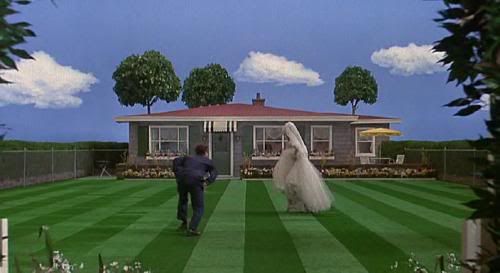
As a flag-flying, bald eagle-owning, passport-wielding Merican, the idea of the American Dream is important to me and my life. When I imagine the American Dream as it is presented in our culture, I think of this scene from Little Shop of Horrors.
It's the perfect image for this idea of the American Dream: the house in the suburbs with the nice neat fence and the nice neat grass, the nice happy marriage, and the nice happy life together. This idyllic scene disgusts me. I mean, I'm fine with people living this life if they want to; I have nothing against that. However, it is not the life for me. I see it as being too stable, too boring. I think that this image is not only against my own desires, but it is against the entire idea of the American Dream. In this country, there is a history of valuing the rights and freedoms of people over the simplification of life. Although traditional gender roles simplify life in a way that is comforting to many, civil rights leaders have worked for over the last century to protect the freedom of those that choose not to follow these guidelines for life. I have personally found that the idea of the American Dream is against stability, as it is all about the ability to rise through social classes and change your life for the better. To me, the American Dream is being able to forge your own path in life and to have society's support for your right to do so.

I think of wealth as a form of power. Those who have much wealth have the power to make more stuff happen than people with less wealth. This stuff can be anything, from sending your face to the moon to putting food on the table. Wealth can even be used, and often is used, to gain more wealth. Everyone needs a certain amount of wealth to survive, but often people desire to have as much of it as they can possibly get because it is so useful.

Both in the context that the Great Gatsby was written in and the context I live in today. wealth defines American society. The rags to rises story is highly valued in our society, whether it be the lucky person that wins the lottery or the frugal factory worker that won the lottery of life. However, this dream is less achievable than our culture likes to admit. With rampant income inequality leading to a distressingly large wealth gap, it is increasingly difficult for many to achieve the American Dream. I think that Americans' attitude towards wealth and poverty has some flaws. There is a vocal minority that pushes the idea that those in poverty simply aren't "pulling themselves up by their own bootstraps." Most Americans seem to realize that this isn't the case, and systemic factors lead to many Americans being unable to realize the American Dream. However, it seems to me that the majority of Americans think of wealth as being earned. There is an assumption that people get paid more if they work harder, which is obviously not the case in North Carolina. Americans tend to find wealth to be a goal in life, although occasionally those who have it are vilified (I would argue often justifiably).

Growing up in the United States and in a position where I have not had to experience poverty has influenced my feeling on wealth. In the U.S., people don't like to talk much about money. It's rude to ask someone their salary, while in Chinese culture asking someone's salary is much more socially acceptable. I don't like the idea of talking about money, and I think I'd share Nick Carraway's belief that excessive wealth is something to be ashamed of rather than flaunted. I think that these feelings show a desire to reach a point at which there is equality of opportunity in our society. However, I think that, when applied to society as a whole, these principles can be more destructive than helpful. By not discussing wealth directly, and with wealthier individuals actively trying to hide their wealth, it makes it more difficult to identify that problems with wealth even exist. Although being able to have some wealth is a part of the American Dream, I think that excessive wealth helps to destroy it for others.

Saturday, March 7, 2015

Insert Kafka Pun Here

Like Queen's Bohemian Rhapsody and The Stranger by Albert Camus, Metamorphosis explores the absurdity of existence and the conflict posed by tragic circumstances. After turning into a large, insectesque figure, Gregor Samsa is isolated from his family and work. I like to think that Kafka uses this physical change as a metaphor for the difficulty of communication with others that he may have felt after confronting the absurdity of existence. I imagine that Meursault may have felt like a cockroach, being looked down on with fear and disgust by society and being unable to get others to understand his philosophy. However, another layer is added to the difficulty of communicating ideas by the fact that I have to read Kafka' work in English, translated from the original German. Here is what I think of some of the translation of the first lines of Metamorphosis.

Notes

#1: As Gregor Samsa awoke one morning from uneasy dreams he found himself transformed in his bed into a gigantic insect.


  • Has a matter-of-fact feel to it due to the lack of punctuation despite the fact that a comma could be added after "dreams"
  • "Gigantic" feels formal compared to the other word choices
  • "As George Samsa awoke" Is a process and a dependent clause; not the most important part of the sentence and occurring as an experience
  • "Uneasy dreams" implies oddness and irregularity, something that would make one feel sick
#2: Gregory Samsa woke from uneasy dreams one morning to find himself changed into a giant bug.
  • Has a matter-of-fact feel to it due to the lack of punctuation despite the fact that a comma could be added after "dreams"
  • "Giant" and "changed" feel too simple, especially with the word "uneasy" being used
  • "Gregory Samsa awoke" isn't a process but rather an event, and is also an independent clause, emphasizing the idea of him waking and making the metamorphosis secondary
  • Doesn't tell that Samsa is in his bed, making the scene painted less clear
#3: When Gregor Samsa awoke from troubled dreams one morning he found he had been transformed in his bed into an enormous bug.
#tfw you get changed into something enormous
  • Lack of punctuation although it could be added after "morning"
  • "Enormous" has a child-like feel to it, like something Roald Dahl would write
  • "When George Samsa awoke" is an event, an instant in time, but it is not an independent clause, making it less important than him finding himself
  • "Troubled dreams" sound lightly burdensome as opposed to sickening, implies negativity rather than irregularity
#4:One morning, upon awakening from agitated dreams, Gregor Samsa found himself, in his bed, transformed into a monstrous vermin.
  • Uses much punctuation, creating a broken feeling, as if the narrator is meandering towards the inevitable reveal
  • "Monstrous vermin" feels strange of Samsa to think of himself, especially considering his nonchalant attitude through the rest of the novel (or at least Part 1) about his condition
  • "Upon awakening" is not even at the beginning of the sentence, making Samsa's experience of consciousness of even less importance
  • "Agitated" and "monstrous" imply that the change was negative, although agitated can be seen as describing Samsa experience of discomfort during his sleep rather than a negative aspect to the change itself
Overall Analysis

The wording of each translation has a large effect on how Samsa's experience of life is communicated. Syntax and punctuation both affect how the experience of consciousness is communicated. I think that the second translation does the best job in this regard, due to it emphasizing Samsa's waking as an experience and does not interrupt his thought process. The diction and imagery in the translation colors Samsa's perception of the scenario and slightly changes meaning in the sentence. I believe the first quote does the best job with imagery, not coloring Samsa's predicament as negative or necessarily unfortunate. I also like how most of the translations use "he found himself" rather than "he found he had been." I think that finding himself rather than finding an action to him had occurred creates a better sense of his experience, describing the strange nature of gaining consciousness and shortly after self-awareness when waking from a dream.

Translation seems incredibly difficult to do. With the different grammatical structures, word connotations and denotations, and cultural contexts that are ingrained within every language, the task of trying to preserve an author's ideas seems almost like trying to recreate an art piece in a new medium. No matter how hard you try, there are going to be differences in your final product that will affect how the piece is interpreted. It makes the idea of even trying to take on translating a novel seem futile. However, between these four translation, I think that I have still been able to understand Kafka's ideas that he was trying to get across through this piece of literature. According to Google Translate, Kafka's writing described Samsa's new form as a "monstrous vermin." However, I think that the choice of most translators to use insect or bug instead better preserves the tone of the sentence, making it more matter-of-fact and indifferent to the peculiar circumstance (one of the many reasons to take Google translate with a grain of salt). Overall, I think that none of these translations was perfect, but all of them add value to the work, doing more than merely translating word for word in order to let us understand Kafka's intentions without knowing his language.